The NRI’s Complete Guide to Buying Land in Bangalore from Abroad
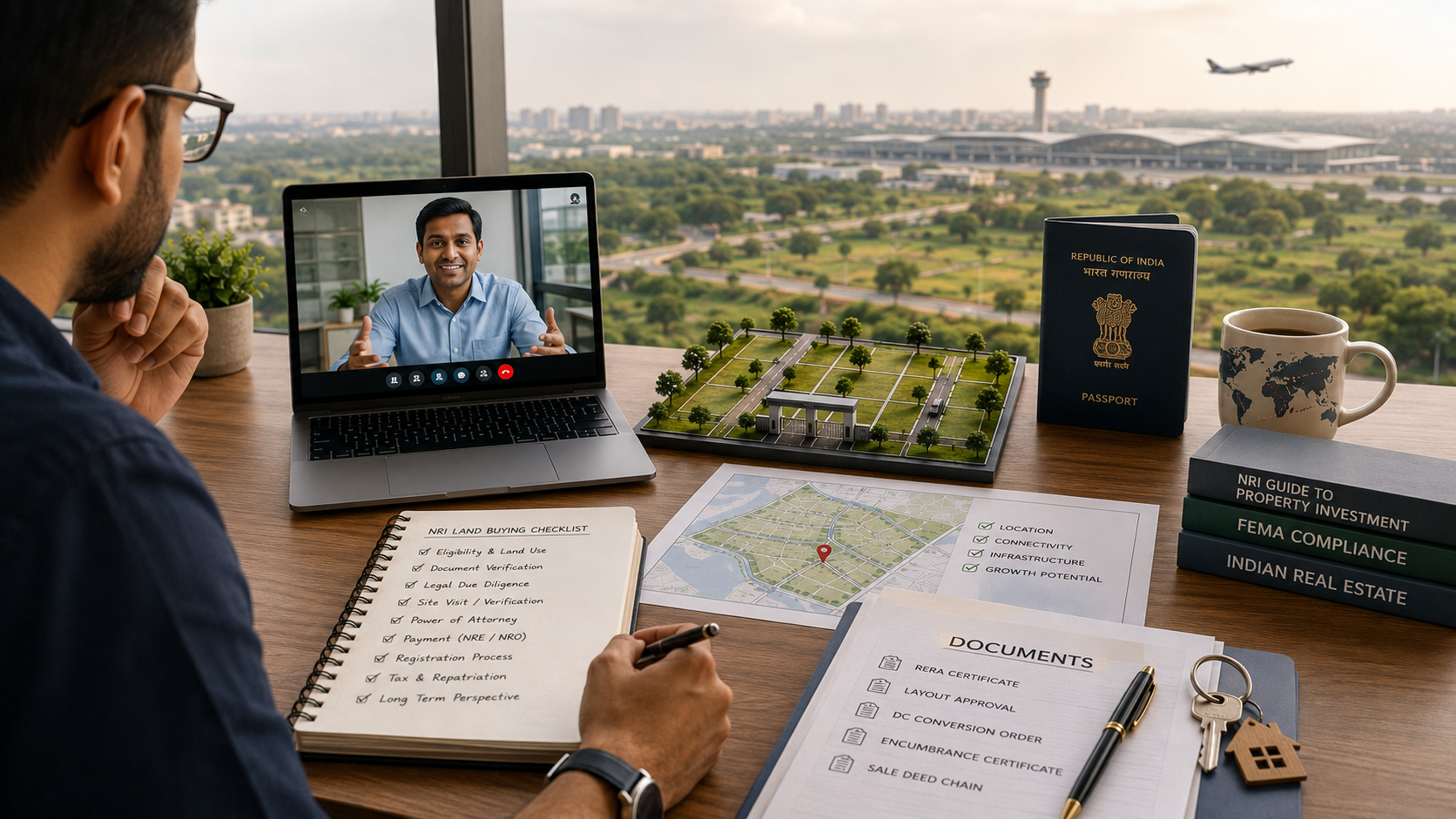
Why Bangalore Continues to Attract NRI Real Estate Investors
For Indians living in the US, UK, UAE, Australia and other global markets, Bangalore remains one of the country's most compelling real estate destinations.
The reasons are easy to understand.
It is a familiar city with a globally recognised technology economy, expanding infrastructure, significant employment generation and long-term residential demand. For many NRIs, there is also an emotional dimension — the opportunity to own an asset in the city they still consider home.
Land, in particular, can be attractive to investors looking for a tangible, long-term asset.
But buying land from abroad requires a different level of due diligence than buying an apartment.
Apartments typically come with relatively standardised developer processes, established documentation and clearly defined units. With land, buyers need to pay particularly close attention to title, land-use classification, approvals, boundaries, access and the credibility of the developer.
For an NRI managing the transaction remotely, having a clear process becomes even more important.
Here is what you should understand before buying land in Bangalore from overseas.
1. Understand What NRIs Can and Cannot Purchase in India
Under India's foreign-exchange regulations, NRIs can generally purchase residential and commercial immovable property in India without obtaining specific RBI approval.
Residential plots within legally approved plotted developments can therefore be considered by NRI buyers, subject to the applicable regulations and documentation.
However, restrictions apply to categories such as agricultural land, plantation property and farmhouses.
This distinction becomes particularly important when evaluating plotted developments on the outskirts of Bangalore, where land may historically have been agricultural.
If agricultural land has subsequently been legally converted for residential use, the relevant conversion and approval documents should form part of your legal due diligence.
Do not rely solely on how the property is marketed.
Verify the actual land-use status with an independent property lawyer before purchasing.
2. Understand How the Payment Process Works
An NRI property purchase should be conducted through permitted banking channels and in accordance with the foreign-exchange regulations applicable at the time of the transaction.
Depending on your circumstances, payments may typically be routed through appropriate NRE or NRO banking arrangements.
Avoid informal payment structures or cash components.
A professional developer should be able to provide proper invoices, receipts and transaction documentation and should be comfortable working with the compliance requirements associated with NRI purchases.
It is also important to understand the tax implications of eventually selling the property.
Tax deduction, capital-gains treatment and repatriation rules can depend on factors including your residential status, holding period and the regulations applicable when the property is sold.
Because these regulations can change, consult a qualified chartered accountant or tax professional before structuring either the purchase or eventual sale.
3. Build Your Independent Due-Diligence Team in India
When purchasing remotely, one of the biggest mistakes is allowing everyone involved in the transaction to represent the seller.
Your lawyer should represent you.
Your chartered accountant should advise you.
And ideally, someone you trust should independently verify what exists on the ground.
Before making a significant payment, have an independent property lawyer review the relevant documentation, including title records, Encumbrance Certificates, approvals, conversion documents where applicable, sanctioned layout and the draft sale agreement.
The objective is straightforward:
Confirm that the property being sold is legally clear, appropriately approved and capable of being transferred to you.
4. Using a Power of Attorney for a Remote Purchase
If you cannot travel to India for every stage of the transaction, a Power of Attorney (PoA) may allow an authorised representative to complete specific actions on your behalf.
This is commonly used by NRIs for property transactions.
However, the PoA should be drafted carefully.
Rather than giving unnecessarily broad authority, speak to your lawyer about creating a transaction-specific Power of Attorney defining exactly what your representative is authorised to do.
Execution, attestation, stamping and registration requirements can vary depending on where the document is signed and how it will be used in India.
Your lawyer should guide you through the current procedure applicable to your transaction.
5. Never Let a Virtual Tour Replace Physical Verification
Technology has made remote property evaluation dramatically easier.
You can attend video calls, view drone footage, examine master plans and walk through developments virtually from almost anywhere in the world.
But a virtual tour remains a presentation.
Whenever possible, visit the site yourself before purchasing.
If that isn't practical, ask a trusted family member, lawyer or independent local representative to inspect the development on your behalf.
Have them verify the actual plot, not simply the project's entrance or model plot.
They should examine access, road development, plot markings, surrounding land uses, elevation, drainage conditions and visible infrastructure.
Ask for continuous video footage of the site rather than only photographs of selected areas.
The objective is to build an independent picture of what you are buying.
6. Verify the Exact Plot, Not Just the Project
A good project does not automatically make every plot identical.
Two plots within the same development can differ substantially in orientation, elevation, road frontage, proximity to amenities and surrounding conditions.
Before finalising a plot, obtain its exact number and dimensions and locate it on the sanctioned layout.
Then have someone physically stand on that plot.
Compare what exists on site with the documentation you have received.
For an overseas buyer, this relatively simple step can prevent considerable confusion later.
7. Developer Selection Matters Even More for NRI Buyers
Developer credibility matters for every real estate buyer.
For someone purchasing from thousands of kilometres away, it matters even more.
Resolving documentation problems, delays or disputes while living abroad can be expensive and time-consuming.
Look beyond the current project's marketing.
Examine the developer's previous work, transparency around approvals, quality of communication and willingness to provide documentation before asking for a significant financial commitment.
Where applicable, independently verify the project's RERA registration.
Also ask practical questions about how the developer handles overseas transactions.
Do they routinely work with NRI buyers?
Can documentation be shared and reviewed digitally?
Can payments be properly documented through permitted banking channels?
Do they understand PoA transactions?
Will you have a consistent point of contact throughout the purchase?
A strong NRI process should reduce uncertainty rather than create more of it.
8. Plan for Registration Before You Pay
Do not wait until the final stages of the transaction to understand how registration will work.
Clarify early whether you intend to be physically present or represented through a valid Power of Attorney.
Ask your lawyer to review the proposed sale deed before execution and understand the applicable stamp duty, registration charges and other statutory costs.
Also make sure the name, address and identification details used across your banking, tax and property documentation are consistent.
Administrative discrepancies that are relatively easy to solve while you are in India can become considerably more frustrating when handled remotely.
9. Think About the Exit Before You Enter
A good investment decision includes thinking about how you might eventually sell.
Ask yourself:
Who is likely to buy this plot from me five, seven or ten years from now?
What infrastructure will make this location more desirable?
Will end users eventually want to live here?
How easily can ownership be transferred?
Are there maintenance or community obligations after possession?
Understanding the likely future buyer helps distinguish an investment based on genuine demand from one based purely on expectations of price appreciation.
This is particularly important when evaluating emerging corridors such as North Bangalore.
Why North Bangalore Is Particularly Relevant for NRIs
North Bangalore offers an interesting combination for overseas investors.
Kempegowda International Airport provides an obvious practical advantage for people who frequently travel between India and other countries.
But the investment story extends beyond airport proximity.
The broader corridor is being shaped by road infrastructure, aerospace and industrial development, employment generation, hospitality, commercial development and expanding residential communities.
For NRIs considering Bangalore land as a long-term investment, the key is not simply identifying an emerging location.
It is finding legally clear, strategically positioned land within a corridor supported by genuine economic and infrastructure fundamentals.
Bulwark's Approach to NRI Investors
At Bulwark Group, we recognise that buying property from another country requires greater transparency and communication.
Our approach is designed to make the process easier to understand from the beginning.
Project information and available documentation can be shared digitally for review before commitment. Virtual site interactions can help overseas buyers understand the development, while our team can coordinate communication around the practical requirements of an NRI transaction.
Where legal, tax or foreign-exchange advice is required, we encourage buyers to obtain independent professional guidance rather than relying solely on information provided by the developer.
Our view is simple:
An informed investor makes a stronger long-term investor.
For an NRI buyer, confidence should come not from a sales pitch, but from understanding the property, independently verifying the documentation and knowing exactly how the transaction will proceed.
About Bulwark Group
At Bulwark Group, we are redefining real estate through transparency, thoughtful planning and infrastructure-aligned developments.
As a premier luxury villa plots developer in Devanahalli, North Bangalore, we specialise in eco-luxury and strategically located plotted developments designed around long-term growth, sustainability and quality of living.
Our developments across North Bangalore and the STRR belt offer investors and homebuyers an opportunity to own high-value real estate near Bengaluru's international airport while enjoying modern amenities, thoughtfully planned communities and serene green spaces.
Our portfolio includes Northern Boulevard, Codename Earthen Woods, Codename Serene Meadows and Codename Enchanted Habitat — developments envisioned to create a harmonious balance between luxury, nature and long-term value.
With trust, transparency and a clear vision for the future at the heart of our approach, Bulwark Group helps investors and homebuyers identify opportunities positioned to participate in North Bangalore's evolving growth story.
Contact Bulwark Group
Location: First Floor, Door No. 3, Reshma Apartments, 196, near Airtel Office, opposite Kotak Bank, Jayamahal Extension, Bengaluru, Karnataka 560046
Email: enquiry@bulwarkgroup.in
Interested in investing in North Bangalore?
Speak to one of our advisors and explore current plot availability in our premium communities.
Talk to an Advisor