The History of North Bangalore: From Granite Quarries to Global Aerospace
A Different Kind of Real Estate Story
Most real estate conversations focus on where a location is going.
New roads. New infrastructure. New employment hubs. Future appreciation.
But sometimes, the clearest way to understand where a place is headed is to understand where it came from.
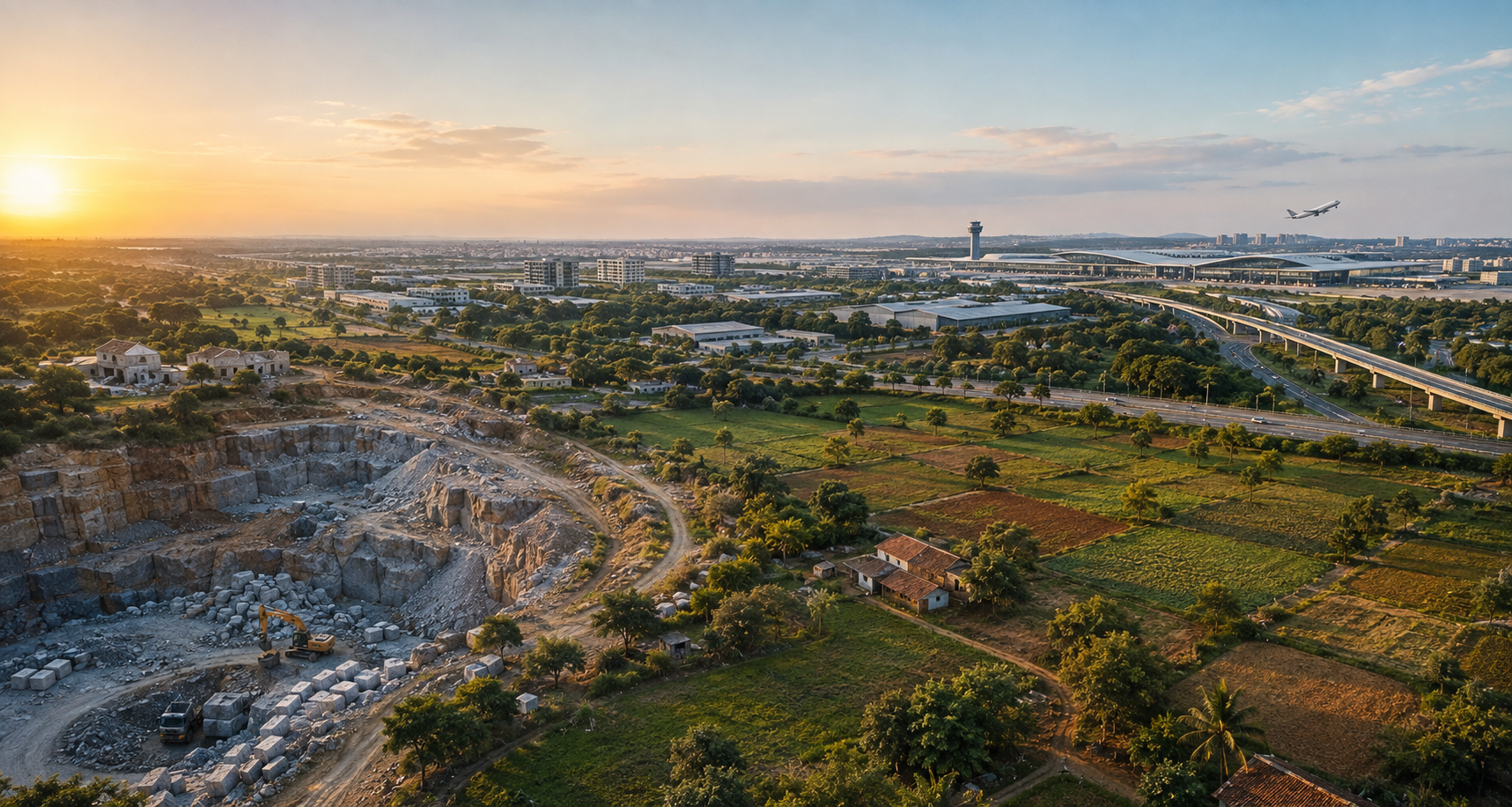
North Bangalore's transformation did not happen overnight. It has unfolded over decades — from an agricultural landscape on Bengaluru's periphery to an international gateway surrounded by aviation, aerospace, manufacturing and rapidly expanding residential development.
And that history provides important context for understanding the opportunity that exists today.
The Pre-Airport Era: Farming, Quarrying and Quiet Corridors
Before North Bangalore became synonymous with airports and investment, much of the Devanahalli belt was predominantly agricultural.
The landscape was characterised by farmland, open tracts of land and granite quarrying that supported Bengaluru's expanding construction industry.
Devanahalli itself, however, has a history stretching back centuries. The town is known for the historic Devanahalli Fort and as the birthplace of Tipu Sultan, giving the region a cultural identity that predates its modern real estate story.
For decades, this remained a relatively quiet part of Bengaluru's outskirts.
Land values were modest, development was limited and the region had little resemblance to the emerging urban corridor we see today.
Then came the decision that would fundamentally alter its trajectory.
2008: The Airport Changes Everything
The opening of Kempegowda International Airport in 2008 was arguably the most consequential event in North Bangalore's modern development.
Almost overnight, Bengaluru's northern edge became the city's primary international gateway.
But the transformation that followed was not instantaneous.
The announcement and development of the airport initially generated significant speculation around surrounding land. Prices moved quickly as investors attempted to anticipate where future growth would occur.
Then came the 2008 global financial crisis.
The speculative enthusiasm cooled, and parts of the market corrected.
What happened afterwards is more important.
Throughout the following decade, North Bangalore began developing the fundamentals required to support sustainable real estate demand rather than purely speculative demand.
Road connectivity improved. Hotels and logistics businesses followed airport activity. Commercial development increased. Employment began moving north.
The airport had started an economic ecosystem.
The Next Layer: Aerospace, Defence and Manufacturing
During the 2010s, another major transformation began taking shape.
North Bangalore increasingly emerged as a strategic location for aerospace, defence, manufacturing and technology-led industries.
Government-backed industrial development around the airport corridor helped attract major companies and supporting businesses, creating an increasingly sophisticated employment ecosystem.
This changed the nature of demand surrounding Devanahalli.
Airport-led hospitality and logistics had already created economic activity. Aerospace, manufacturing and technology added something particularly important for residential real estate:
a skilled, long-term workforce.
Engineers, managers, technicians and professionals working within these employment clusters require more than offices and factories.
They require homes.
And as employment ecosystems deepen, demand typically follows for schools, hospitals, retail, recreation, hospitality and other infrastructure required to support everyday life.
North Bangalore was no longer simply Bengaluru's airport corridor.
It was becoming an economic corridor in its own right.
Infrastructure Begins Connecting the Pieces
The next stage of North Bangalore's evolution has been about connectivity.
Major road infrastructure, including the Satellite Town Ring Road (STRR), along with improvements to highways and arterial connections, is gradually changing how the region connects with the rest of Bengaluru.
This matters because infrastructure does more than shorten travel times.
It changes the economic radius of a location.
Land that once appeared peripheral becomes accessible. Businesses gain larger catchment areas. Residential development becomes practical for a broader population.
And areas surrounding established employment and transportation infrastructure begin evolving into communities rather than isolated developments.
North Bangalore in 2026: A Corridor in Mid-Transition
Today, North Bangalore sits at an interesting point in its development cycle.
It is no longer an untested peripheral market.
The airport is operational and expanding. Employment clusters exist. Major infrastructure is visible. Commercial activity has grown substantially, and residential development is following.
At the same time, the corridor has not reached the density or maturity associated with Bengaluru's established eastern and southern markets.
That distinction matters.
There is a significant difference between investing when infrastructure exists only on a planning document and investing after an area has already reached maturity.
North Bangalore increasingly sits between those two stages.
The fundamental growth drivers are visible, while much of the surrounding urban ecosystem is still developing.
Bengaluru Has Seen This Pattern Before
North Bangalore's story is unique, but the broader pattern is familiar.
Whitefield was once considered distant from central Bengaluru before technology employment transformed the eastern corridor.
Sarjapur Road evolved as employment, connectivity and residential development reinforced one another.
Electronic City underwent a similar transformation as infrastructure and employment gradually converted peripheral land into an established urban market.
The exact timelines and outcomes differ, and past performance never guarantees what another corridor will achieve.
But Bengaluru's history repeatedly demonstrates one principle:
Infrastructure and employment have the ability to redraw the city's real estate map.
North Bangalore is experiencing that process today.
From Speculation to Fundamentals
Perhaps the most important change in North Bangalore is not visible in a skyline.
It is the changing reason people are interested in the region.
Early interest was heavily influenced by speculation surrounding the airport.
Today's investment case is considerably broader.
It includes airport-led economic activity, aerospace and industrial employment, major road infrastructure, commercial development, improving social infrastructure and growing residential demand.
That represents an important transition.
A corridor driven by the possibility of future development is fundamentally different from one where the foundations of that development are already visible.
The Bulwark Position
At Bulwark Group, our interest in the Devanahalli and North Bangalore corridor is rooted in these fundamentals.
We believe strong real estate opportunities begin with understanding why a location should grow, not simply assuming that it will.
North Bangalore combines three important elements: significant infrastructure investment, established and emerging employment anchors, and the physical availability of land capable of supporting thoughtfully planned communities.
Its history shows how dramatically the region has already evolved.
Its current development suggests that transformation is not yet complete.
We are therefore not simply developing plotted communities in another emerging location.
We are participating in a corridor whose story has evolved from farmland and granite quarries to an international airport, aerospace industries and a new generation of residential communities.
And the next chapter is still being written.
About Bulwark Group
At Bulwark Group, we are redefining real estate through transparency, thoughtful planning and infrastructure-aligned developments.
As a premier luxury villa plots developer in Devanahalli, North Bangalore, we specialise in eco-luxury and strategically located plotted developments designed around long-term growth, sustainability and quality of living.
Our developments across North Bangalore and the STRR belt offer investors and homebuyers an opportunity to own high-value real estate near Bengaluru's international airport while enjoying modern amenities, thoughtfully planned communities and serene green spaces.
Our portfolio includes Northern Boulevard, Codename Earthen Woods, Codename Serene Meadows and Codename Enchanted Habitat — developments envisioned to create a harmonious balance between luxury, nature and long-term value.
With trust, transparency and a clear vision for the future at the heart of our approach, Bulwark Group helps investors and homebuyers identify opportunities positioned to participate in North Bangalore's evolving growth story.
Contact Bulwark Group
Location: First Floor, Door No. 3, Reshma Apartments, 196, near Airtel Office, opposite Kotak Bank, Jayamahal Extension, Bengaluru, Karnataka 560046
Email: enquiry@bulwarkgroup.in
Interested in investing in North Bangalore?
Speak to one of our advisors and explore current plot availability in our premium communities.
Talk to an Advisor