Plot Dimensions Explained: Why Frontage, Depth and Orientation Matter
When buyers compare plots, one number usually gets most of the attention: square feet.
A 1,500 sq. ft. plot sounds straightforward. So does a 2,400 sq. ft. plot.
But area alone doesn't tell you how comfortably that land can be used.
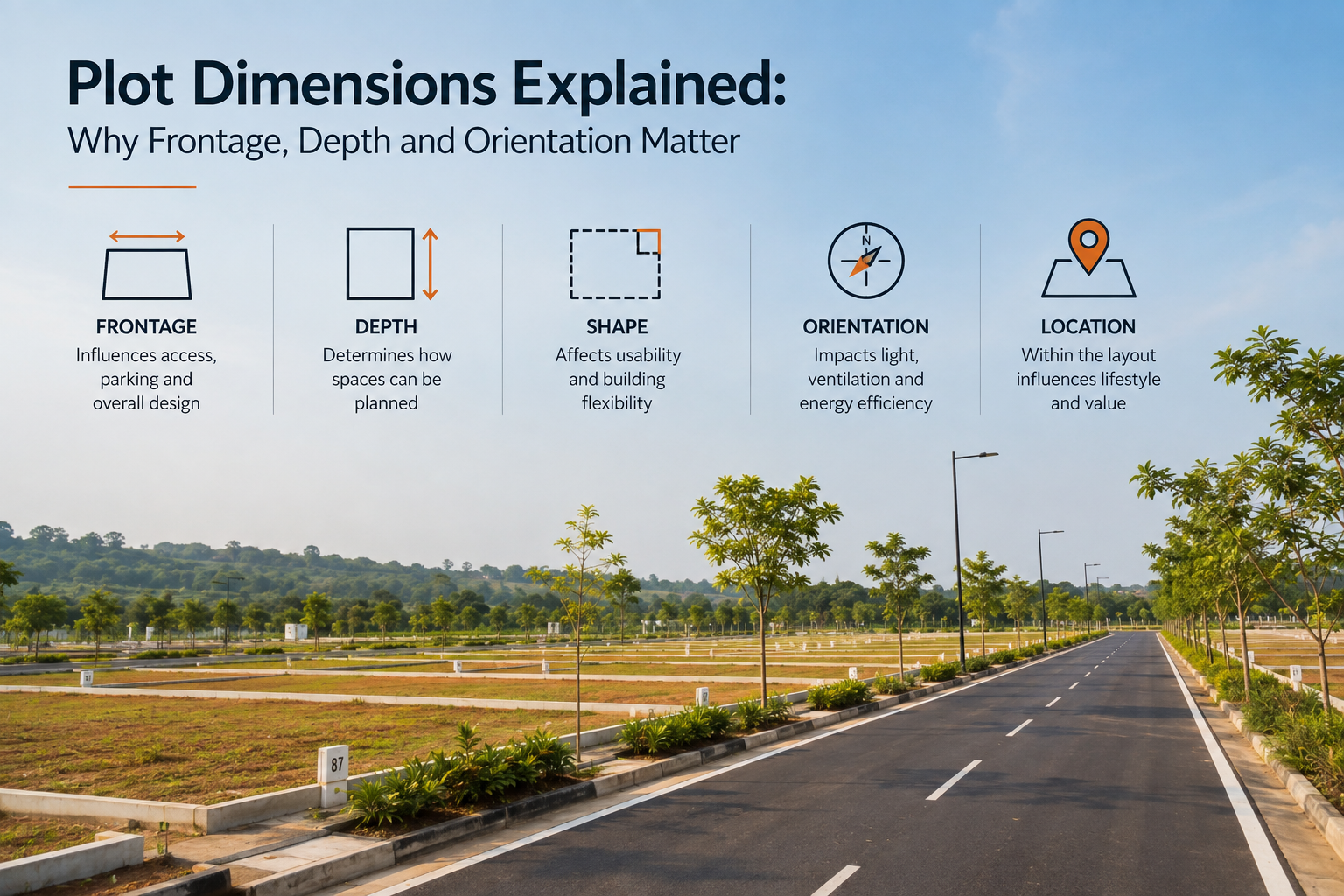
Two plots can have exactly the same total area and offer very different possibilities depending on their frontage, depth, shape, orientation and relationship with the road.
That's why understanding plot dimensions is an important part of evaluating plotted real estate.
Plot Area Is Only the Starting Point
Imagine two plots, both measuring 1,500 sq. ft.
One is relatively wide with balanced proportions.
The other is narrow and significantly deeper.
On paper, you're buying exactly the same amount of land.
But when you begin planning a home, the experience can be quite different.
The position of rooms, parking, setbacks, entrances, outdoor areas and circulation can all be influenced by the dimensions of the plot.
The better question, therefore, isn't simply:
"How large is the plot?"
It's:
"How usable is the plot?"
1. What Is Frontage?
Frontage generally refers to the width of your plot along the road it faces.
It plays an important role in how a home can be positioned and accessed.
Depending on the plot and applicable building regulations, greater frontage may provide more flexibility for elements such as the entrance, driveway, parking, landscape and overall building configuration.
A narrow frontage isn't automatically a disadvantage. Many excellent homes are designed on narrower plots.
What matters is understanding whether the dimensions suit the kind of home you eventually want to build.
2. Why Does Plot Depth Matter?
Depth is the distance from the front boundary of the plot to the rear.
Just as frontage influences the width available for planning, depth affects how spaces can be arranged from the front of the property towards the back.
A very deep plot may require a different design approach from one with more balanced proportions.
This becomes particularly relevant once setbacks and other applicable building requirements are considered.
Before choosing a plot, it can be useful to think beyond the land itself and imagine the building footprint that may eventually sit within it.
3. Plot Shape Can Change Usability
Not every plot is a perfect rectangle.
Some may have irregular boundaries, tapered edges or other variations created by the overall site layout.
That doesn't necessarily make them undesirable.
But it does make understanding usability more important.
An irregular plot might offer an interesting architectural opportunity, while in another case it could create areas that are more difficult to incorporate into the eventual home design.
This is why buyers should look at both the total area and actual dimensions before comparing plots purely on price per square foot.
4. What Does Plot Orientation Mean?
Orientation generally refers to the direction a plot faces and how the property sits in relation to its surroundings.
Buyers in India often have personal preferences regarding direction, including considerations related to Vastu.
From a design perspective, orientation can also influence how architects think about daylight, heat, ventilation and the placement of different spaces within a future home.
There isn't necessarily one orientation that works for every buyer.
The important thing is to understand what you're choosing and whether it aligns with your personal priorities and future building plans.
5. Look at What's Around the Plot
A plot shouldn't be evaluated in isolation.
Where is the internal road?
What's opposite the plot?
Is it close to a park or another open space?
How far is it from the entrance?
Where are the major amenities?
What kind of development is planned beside or behind it?
A plot's position within the larger masterplan influences the experience of living there.
Some buyers may prefer being close to active community spaces.
Others may prioritise quieter internal locations.
Neither is automatically better. It depends on what you're looking for.
6. Corner Plots Need Their Own Evaluation
Corner plots often attract attention because they have road exposure on two sides.
This can create interesting possibilities for access, architecture and openness.
But buyers should evaluate them practically rather than assuming they're automatically superior.
Understand the applicable setbacks, road relationships, plot dimensions and how your eventual home might be positioned.
The value of a corner plot depends on how well its characteristics align with your needs.
7. Think About the Home Before Choosing the Land
You don't need a completed architectural plan before buying a plot.
But having a rough idea of what you eventually want to build can make the selection process much more meaningful.
Do you want substantial outdoor space?
Parking for multiple vehicles?
A larger ground-floor footprint?
A garden?
More privacy?
A home that can potentially accommodate changing family requirements?
Thinking about these questions helps you evaluate whether the dimensions of a plot support your plans rather than simply meeting a preferred square-footage number.
8. Understand Setbacks and Building Regulations
Owning a certain amount of land does not necessarily mean the entire area can be covered by a building.
Applicable planning and building regulations may determine requirements such as setbacks and permissible construction parameters.
These can vary depending on factors including the location, plot dimensions, road width and relevant authority.
Before finalising a plot—particularly if you already have specific construction plans—understand the regulations applicable to that property and seek professional guidance where required.
Why Good Plot Planning Matters at the Development Level
Plot configuration isn't only a buyer consideration.
It's also a masterplanning decision.
When land is developed, there can be pressure to maximise saleable area and inventory.
But the number of plots created shouldn't be the only measure of planning efficiency.
Roads need to function.
Open spaces need to be meaningful.
Infrastructure needs room.
And individual plots need dimensions that allow buyers to eventually create usable homes.
A successful plotted development therefore needs to balance land efficiency with long-term usability.
Don't Compare Plots on Square Footage Alone
When you're standing at a sales office looking at a layout, it's easy for plot selection to become a comparison of numbers.
1,200 sq. ft.
1,500 sq. ft.
2,400 sq. ft.
But before deciding, look one level deeper.
Check the frontage.
Check the depth.
Understand the shape.
Consider the orientation.
Look at where the plot sits within the community.
And think about what you may eventually want to build there.
At Bulwark Group, we believe a well-planned plot should give its owner possibilities, not unnecessary constraints.
Because ultimately, you're not simply buying square feet of land.
You're buying the space on which something much more personal may eventually take shape.
About Bulwark Group
Bulwark Group is a premier luxury villa plots developer in Devanahalli, North Bangalore, specializing in eco-luxury and strategically located plotted developments. Committed to excellence and sustainable living, Bulwark offers visionary investors and homebuyers a unique opportunity to own high-value real estate with long-term growth potential near Bangalore’s airport. Their projects, including the acclaimed Northern Boulevard, feature modern amenities and serene green spaces, creating a harmonious blend of luxury and nature.
Contact Bulwark Group
Interested in investing in North Bangalore?
Speak to one of our advisors and explore current plot availability in our premium communities.
Talk to an Advisor