Before You Buy Land: A Plain-English Guide to Titles, Approvals and Documents
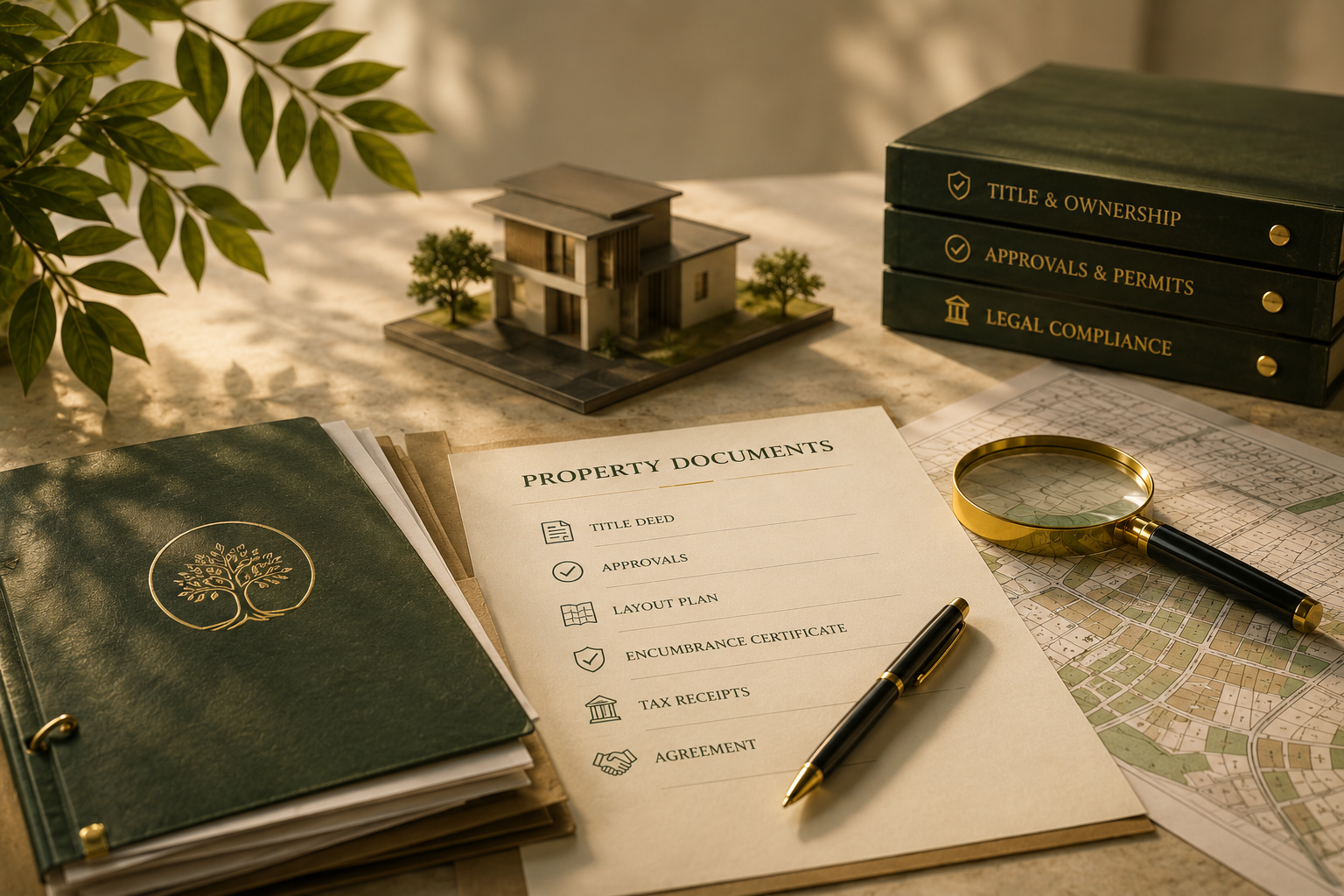
Buying land isn't only about finding the right location, plot size or price.
Before any of those considerations become meaningful, there is a more fundamental question:
What exactly are you buying, and is everything in order on paper?
Property documentation can feel intimidating, especially when terms such as title, encumbrance, conversion, Khata and planning approvals begin appearing in conversations.
But buyers don't need to become property lawyers to ask the right questions.
They do need to understand what these documents broadly represent, why they matter and when professional verification is necessary.
Here's a straightforward starting point.
1. Start With the Title
In simple terms, the title relates to the legal ownership of the property.
Before buying land, you need clarity on who owns it and whether the person or entity selling it has the legal right to do so.
This typically requires reviewing the chain of ownership and relevant supporting documents rather than relying only on the most recent document.
Think of it this way:
You're not simply checking who is selling the land today.
You're establishing how ownership reached them.
This is one of the areas where independent legal due diligence is particularly important.
2. What Is a Title Chain?
Land may have changed hands several times over the years.
A title chain traces that history through the relevant ownership documents.
Why does this matter?
Because an issue from an earlier transaction can potentially affect a later one.
A qualified property lawyer can examine the available records and determine whether the ownership trail is sufficiently clear for the proposed transaction.
For buyers, the important principle is simple:
Don't evaluate ownership based on one document alone.
3. Understand Encumbrances
An encumbrance broadly refers to a claim, liability or interest that may affect a property.
Buyers will often hear about an Encumbrance Certificate (EC) during property due diligence.
The EC can provide information about certain registered transactions relating to a property during a specified period.
It is an important document, but it should form part of a broader legal review rather than being treated as the only proof required before purchasing land.
Ask your legal advisor what period should be checked and whether any additional searches or documents are required for the specific property.
4. Understand the Land's Permitted Use
Another important question is:
What can this land legally be used for?
Land records and applicable planning regulations determine how land may be used and developed.
Depending on the property's history and location, buyers may encounter documentation relating to land conversion or change of land use.
For a plotted residential development, it is important to understand whether the land's status and proposed use are appropriate for the development being offered.
Don't rely only on how the property is marketed.
Verify the relevant documentation.
5. Who Approved the Layout?
A plotted development isn't simply a large parcel divided into smaller rectangles.
The layout may need approval from the relevant planning authority based on its location and applicable regulations.
An approved layout establishes important aspects of the development such as roads, plot configuration, open spaces and other planning components.
Buyers should ask:
Which authority has approved this development?
Then review the relevant approval documents as part of the due-diligence process.
6. What Does RERA Tell You?
Where a real estate project falls within the applicable scope of the Real Estate (Regulation and Development) Act, buyers should check its RERA registration and the information available through the relevant regulatory authority.
RERA disclosures can provide buyers with useful project-related information.
However, RERA registration should not be treated as a substitute for your own legal due diligence.
It is one part of evaluating a property, not the entire process.
7. What Is Khata?
Buyers in Karnataka frequently hear the word Khata during property discussions.
Broadly, Khata relates to municipal or local-authority property records used for administrative and taxation purposes.
The exact documentation and authority involved can depend on where the property is located.
Rather than relying on shorthand descriptions, ask what property records apply to the specific plot you're purchasing and have them reviewed as part of your legal verification.
8. Read the Agreement, Not Just the Brochure
Marketing material helps you understand a project's proposition.
Your agreement defines the transaction.
Before signing, carefully review the relevant contractual documents.
Understand:
The plot being purchased
The agreed consideration
Payment terms
What is included in the transaction
Applicable charges
Development commitments
Timelines where specified
Rights and obligations of the parties
Conditions relating to cancellation or default
Maintenance-related provisions
Any other terms affecting ownership or use
If you don't understand a clause, ask.
And if necessary, have your legal advisor explain its implications before you sign.
9. Make Sure the Plot on Paper Matches the Plot You Saw
This sounds obvious, but it deserves attention.
The plot number, dimensions, boundaries and location referred to in the transaction documents should correspond with the property you have selected.
Review the sanctioned or approved layout and understand exactly where your plot sits within the development.
The land you visited and the land described in your documentation should tell the same story.
10. Keep Copies of Everything
Property ownership is a long-term commitment.
Maintain organised copies of the relevant documents associated with your purchase.
This may include agreements, payment records, registration documents, applicable approvals, correspondence and other transaction-related records.
Don't assume you'll always be able to retrieve everything easily years later.
Good documentation today can make future processes considerably easier.
Red Flags Should Lead to Questions, Not Assumptions
During due diligence, something may occasionally be unclear.
A name may differ between documents.
A date may need explanation.
A particular approval may require clarification.
That doesn't automatically tell you whether a property is suitable or unsuitable.
It tells you that you need an answer.
Ask the developer or seller for clarification and supporting documentation.
Then allow your independent legal advisor to assess whether the explanation and records are satisfactory.
When it comes to land, uncertainty should be investigated rather than ignored.
Why Independent Legal Verification Matters
A sales representative can explain a project.
A developer can provide documents.
But the professional assessing those documents on your behalf should ideally represent your interests.
Engaging an independent property lawyer gives you an additional layer of scrutiny before committing significant capital.
The cost of legal due diligence is relatively small compared with the financial commitment involved in purchasing land.
More importantly, it gives you an opportunity to identify and understand issues before the transaction is completed.
Good Property Decisions Begin With Clarity
It's natural to get excited about a beautiful development, a promising location or a plot that feels right.
But property decisions should withstand scrutiny on paper too.
Before you buy, understand:
Who owns the land?
Is the ownership trail clear?
What is the permitted land use?
Which approvals apply?
What exactly does your agreement promise?
And has an independent professional reviewed the documentation?
At Bulwark Group, we believe confidence in a property decision should come from more than what you see during a site visit.
It should also come from understanding what you're signing.
Disclaimer: This article is intended for general informational purposes only and does not constitute legal advice. Property documentation and approval requirements vary depending on the location, transaction and applicable regulations. Buyers should conduct independent legal due diligence and consult qualified professionals before making a property purchase.
About Bulwark Group
Bulwark Group is a premier luxury villa plots developer in Devanahalli, North Bangalore, specializing in eco-luxury and strategically located plotted developments. Committed to excellence and sustainable living, Bulwark offers visionary investors and homebuyers a unique opportunity to own high-value real estate with long-term growth potential near Bangalore’s airport. Their projects, including the acclaimed Northern Boulevard, feature modern amenities and serene green spaces, creating a harmonious blend of luxury and nature.
Contact Bulwark Group
Location: North Bangalore, Near Devanahalli Airport, Bangalore, Karnataka, India
Phone: +91-9199193200
Email: info@bulwarkgroup.in
Website: www.bulwarkgroup.in
Interested in investing in North Bangalore?
Speak to one of our advisors and explore current plot availability in our premium communities.
Talk to an Advisor