10 Things That Will Be True About North Bangalore in 2032
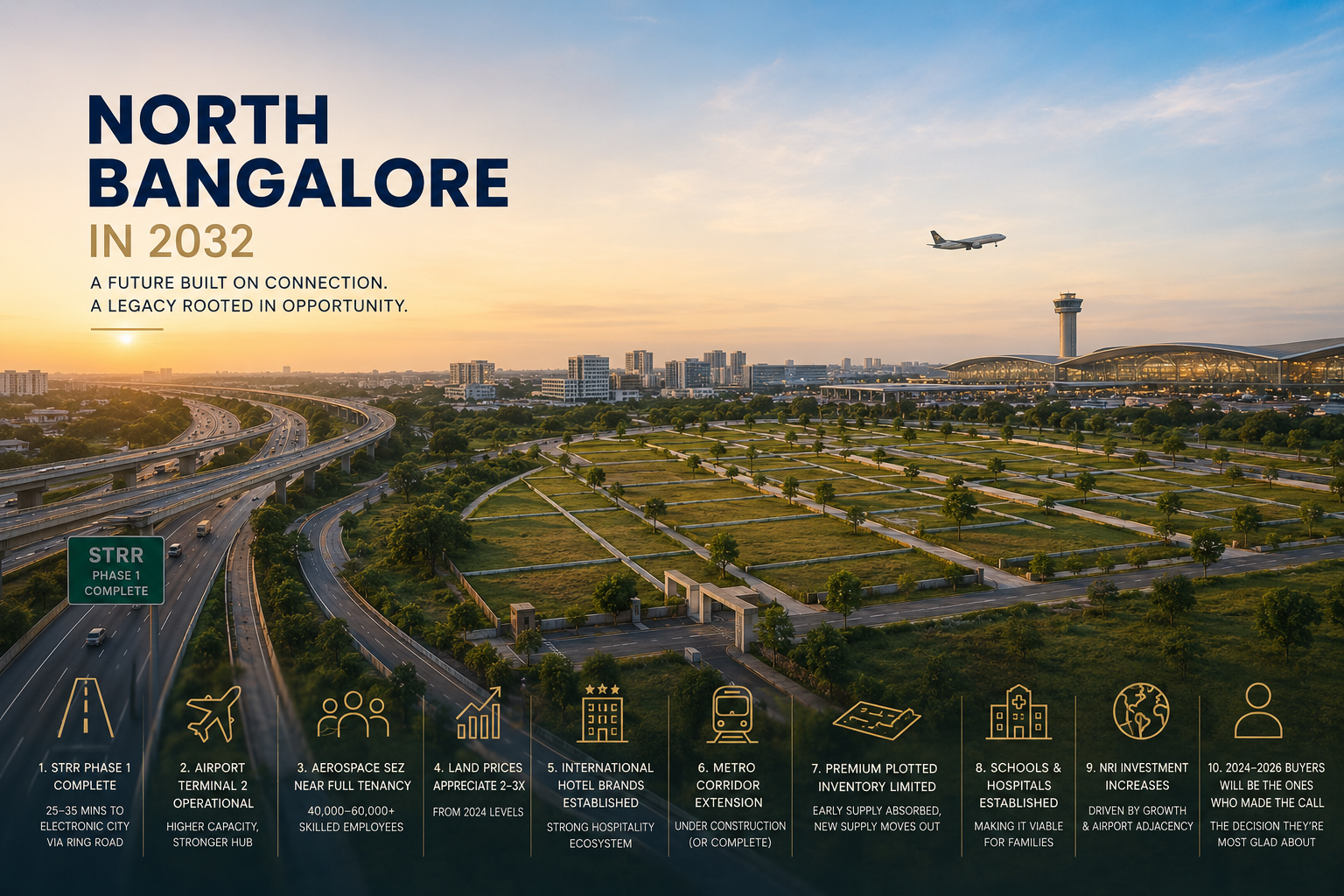
Projecting Forward: A Structured Scenario
Real estate investment is ultimately a bet on what a location will become.
The strongest investment decisions are rarely based on vague optimism. They come from looking at infrastructure, employment, connectivity, development patterns and demand — and building a realistic picture of where a corridor could be five or ten years from now.
For North Bangalore and the Devanahalli belt, that picture is becoming increasingly clear.
Based on infrastructure plans, employment growth and the way Bengaluru's previous growth corridors have evolved, here are 10 things we believe could define North Bangalore by 2032.
1. The STRR Will Fundamentally Change How North Bangalore Connects to the City
The Satellite Town Ring Road (STRR) has the potential to reshape Bengaluru's effective geography.
As connectivity improves between North Bangalore and major employment corridors around the city, Devanahalli will increasingly become part of a much larger, interconnected economic region rather than being viewed primarily as an airport corridor.
For residents and businesses, that means easier movement. For landowners and investors, it means something even more important: a much larger potential catchment.
2. Kempegowda International Airport Will Be an Even Stronger Economic Anchor
Kempegowda International Airport is already one of the most important growth engines in North Bangalore.
By 2032, increasing passenger capacity, commercial development and the broader ecosystem surrounding the airport are likely to strengthen its role far beyond aviation.
Hotels, offices, logistics, retail, hospitality and supporting businesses tend to follow major international airports, creating employment and sustained demand for nearby residential and commercial development.
For Devanahalli, the airport isn't simply an infrastructure advantage. It is a long-term economic anchor.
3. Aerospace and Industrial Employment Will Create Deeper Residential Demand
The aerospace, defence, manufacturing and technology ecosystem developing around Devanahalli is another important piece of the North Bangalore story.
As these employment clusters mature, thousands of professionals will require housing, services, schools, healthcare and everyday infrastructure within practical commuting distance.
This shift could gradually transform North Bangalore from a market driven largely by future investment potential into a genuine live-work ecosystem with sustained end-user demand.
4. Land Values Could Look Very Different From Today's
Infrastructure-led corridors rarely appreciate in a straight line.
Their most significant shifts often occur when major projects move from announcements and construction to visible, functioning infrastructure.
If North Bangalore follows patterns seen across Bengaluru's earlier growth corridors, today's land values may look considerably different by 2032.
The opportunity, therefore, isn't simply to buy land. It is to identify well-located, legally clear and thoughtfully planned land before the surrounding ecosystem fully matures.
5. The Airport Hospitality Ecosystem Will Expand
International airports create economies around themselves.
Hotels, convention facilities, business centres, restaurants and other hospitality infrastructure are likely to continue expanding around Kempegowda International Airport as passenger and corporate traffic grows.
Every additional layer of commercial infrastructure strengthens the surrounding market.
Over time, this means North Bangalore becomes less dependent on expectations about what may arrive in the future and increasingly supported by real businesses, employment and economic activity already operating within the corridor.
6. Metro Connectivity Will Bring North Bangalore Closer
Metro expansion is expected to become another important chapter in North Bangalore's development.
As Bengaluru's public transport network continues extending northwards, areas that once felt geographically distant can become considerably more accessible.
This changes more than commute times.
Better public transport can influence where people are willing to live, where companies establish offices and where supporting commercial development emerges.
In Bengaluru, improved accessibility has repeatedly been one of the strongest catalysts for changing how people perceive — and ultimately value — a location.
7. Well-Positioned Plotted Developments Will Become Harder to Find
Land is fundamentally different from most other real estate assets.
You cannot manufacture more of it in the best locations.
As development progresses, large contiguous parcels with strong road access, clear approvals and proximity to major infrastructure are gradually absorbed.
Development activity then tends to move further outward in search of available land.
By 2032, buyers looking for plotted developments in established parts of the North Bangalore growth corridor may discover that the most strategically positioned opportunities were available much earlier in the development cycle.
8. Schools, Hospitals and Everyday Infrastructure Will Catch Up
A corridor becomes truly residential only when families can comfortably live there.
That requires more than roads, airports and employment.
It requires schools, hospitals, retail, recreation, restaurants and the everyday services that turn an emerging location into an established community.
As North Bangalore's population and employment base increase, these supporting ecosystems are likely to deepen.
That could make the region increasingly viable for permanent family living rather than being viewed primarily as a future investment destination.
9. NRI Interest in North Bangalore Will Continue to Grow
For NRI investors, North Bangalore has a particularly compelling advantage: its proximity to Bengaluru's international gateway.
For someone living overseas, owning property within easy reach of the airport can have both practical and investment appeal.
As infrastructure becomes more visible and the corridor matures, the combination of airport accessibility, plotted land opportunities and long-term development potential could make North Bangalore increasingly attractive to overseas buyers looking to participate in Bengaluru's growth.
10. The 2024–2026 Period May Eventually Be Remembered as an Early Window
Every major Bengaluru growth corridor has a period that looks obvious only in hindsight.
Whitefield had one.
Sarjapur had one.
Electronic City had one.
North Bangalore may eventually have the same story.
By 2032, investors who entered during the earlier stages of infrastructure development may look back at the 2024–2026 period very differently from those evaluating the corridor after its transformation becomes clearly visible.
That does not mean every piece of land purchased today will automatically become a successful investment.
Location, approvals, planning, connectivity and developer credibility will continue to matter.
But the broader window may prove significant.
Looking Towards 2032
These projections are not guarantees.
Real estate markets evolve. Infrastructure timelines can change. Economic cycles fluctuate. Individual developments perform differently depending on their location, planning and execution.
But good investment decisions do not require absolute certainty.
They require understanding the direction in which a market is moving and determining whether the forces driving that movement are credible.
North Bangalore today has several of those forces working simultaneously: airport-led development, road infrastructure, employment creation, commercial expansion, improving connectivity and increasing residential demand.
For an investor in 2026, the question therefore isn't simply:
"What is North Bangalore worth today?"
A more useful question may be:
"What could this corridor look like in 2032 — and what will it cost to enter once that future becomes obvious?"
About Bulwark Group
At Bulwark Group, we are redefining real estate through transparency, thoughtful planning and infrastructure-aligned developments.
As a premier luxury villa plots developer in Devanahalli, North Bangalore, we specialise in eco-luxury and strategically located plotted developments designed around long-term growth, sustainability and quality of living.
Our developments across North Bangalore and the STRR belt offer investors and homebuyers an opportunity to own high-value real estate near Bengaluru's international airport while enjoying modern amenities, thoughtfully planned communities and serene green spaces.
Our portfolio includes Northern Boulevard, Codename Earthen Woods, Codename Serene Meadows and Codename Enchanted Habitat — developments envisioned to create a harmonious balance between luxury, nature and long-term value.
With trust, transparency and a clear vision for the future at the heart of our approach, Bulwark Group helps investors and homebuyers identify opportunities positioned to participate in North Bangalore's evolving growth story.
Contact Bulwark Group
Location: First Floor, Door No. 3, Reshma Apartments, 196, near Airtel Office, opposite Kotak Bank, Jayamahal Extension, Bengaluru, Karnataka 560046
Email: enquiry@bulwarkgroup.in
Interested in investing in North Bangalore?
Speak to one of our advisors and explore current plot availability in our premium communities.
Talk to an Advisor